top of page
Er Ci (Evelyn) Cai
About Me
Musical Performer & playwright
From Groton School
282 Farmers Row, Groton, MA 01450
Email: ecai27@groton.org
Performing
In every turn and melody upon the stage, I seek the echoes of a character’s soul. Here are the footprints of my journey in musical —a collection of artistic moments woven from devotion and the warmth of the spotlight.
2024
ALL GONE Project
tutor & interpreter
add description
2024
Groton Clue on Stage
performer
add description
2025
Chicago
performer
add description
Chicago clip
Making clip
2025
the Art of Making Tea
playwright & Stage director
add description
Visual

01
Bleached
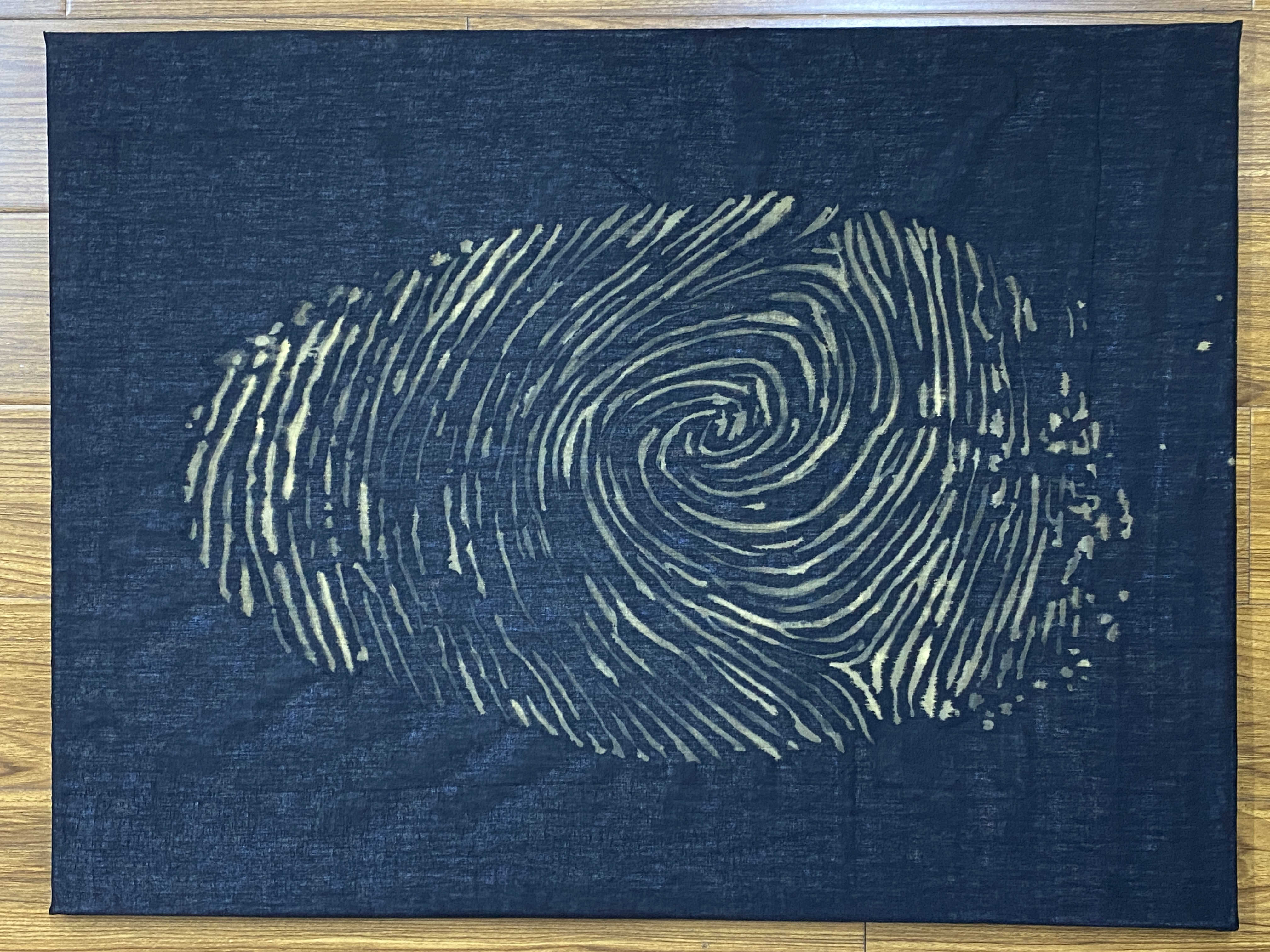
The oversized fingerprint in this work is painted on black cloth using bleach. By definition, to bleach something means to cause a material such as cloth, paper, or hair, to become white or much lighter by a chemical process or by exposure to sunlight. This idea of exposure, specifically by means of privacy, is of paramount importance in our society today. It begs us to ask the question, "Do we really live in a free society where our every move, be it digitally or physically, is tracked and monitored?" While there are those who would argue that if you haven't done anything illegal, you shouldn't have to worry. But the fact is, if history has taught us one thing, it's that you don't have to do illegal things to be suppressed, marginalized, investigated, or in extreme cases, sent to prison camps. Having painted the cloth with bleach, the individual is exposed by way of their indexical mark, and in doing so, is made available for all to see, regardless of their right to privacy.
02
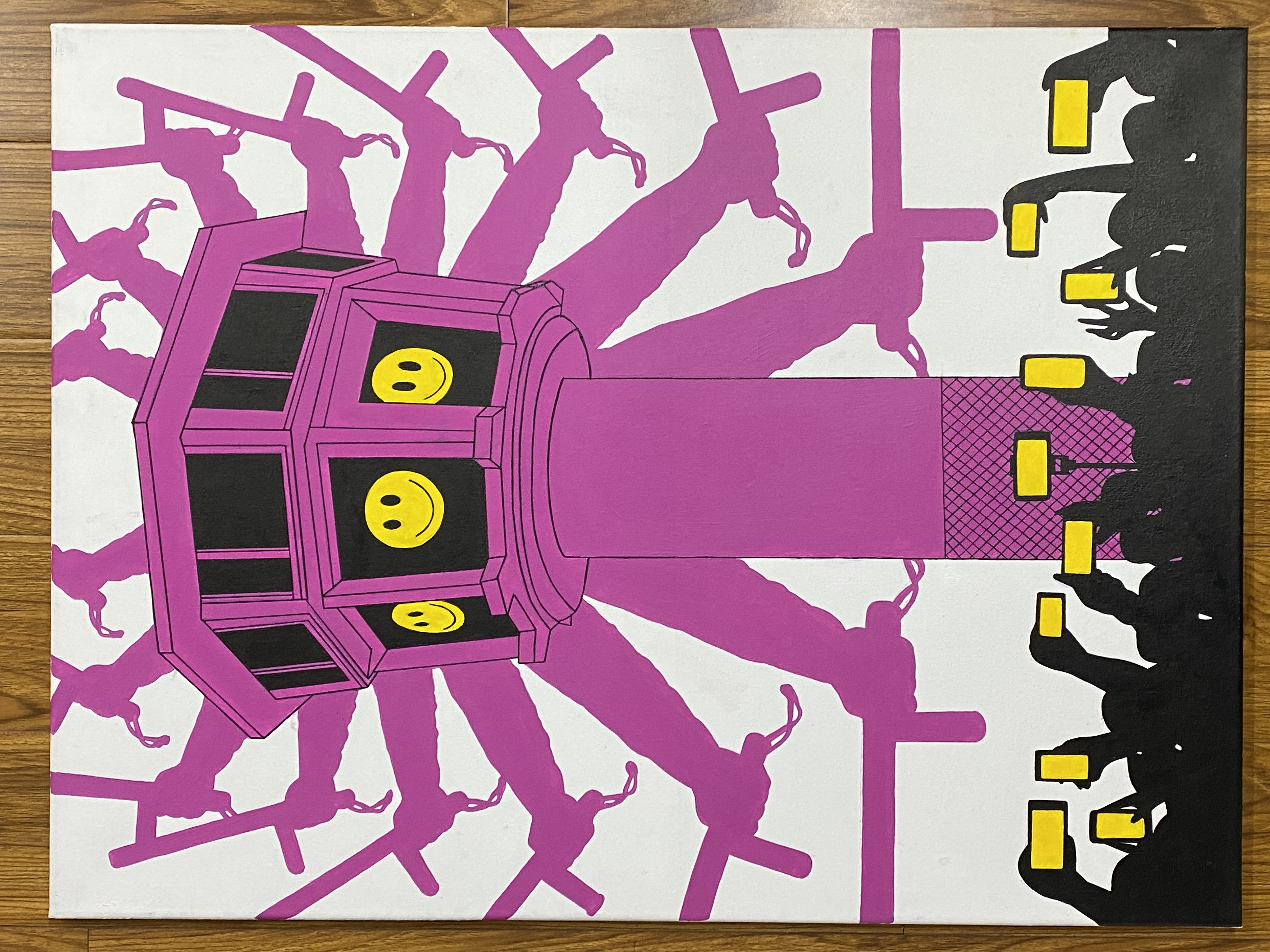
Nothing to See Here
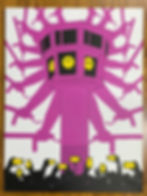
Is democracy dying? This work, entitled, Nothing to See Here, plays on the idea of perspective, specifically in regards to what the masses are focused on as opposed to what's really going on. The painting presents a panoptic structure that gazes down upon their citizens. The two way windows of the watchtower act as a facade. Authoritarian power presents a smiley face, painted in bright yellow that personifies an outward appearance of optimism or pleasure. This image is seized by an ignorant populace who dismiss the obvious in favor of embracing their own enslavement. Armed with batons and show or force, the symbols of state machinery fan out in a sunburst pattern indicative of an agitprop poster from days gone by. Painted in pink, the authoritarian regime saps the energy of the populace. The work functions as a stark reminder that if we forget the past, we are condemned to repeat it.

03
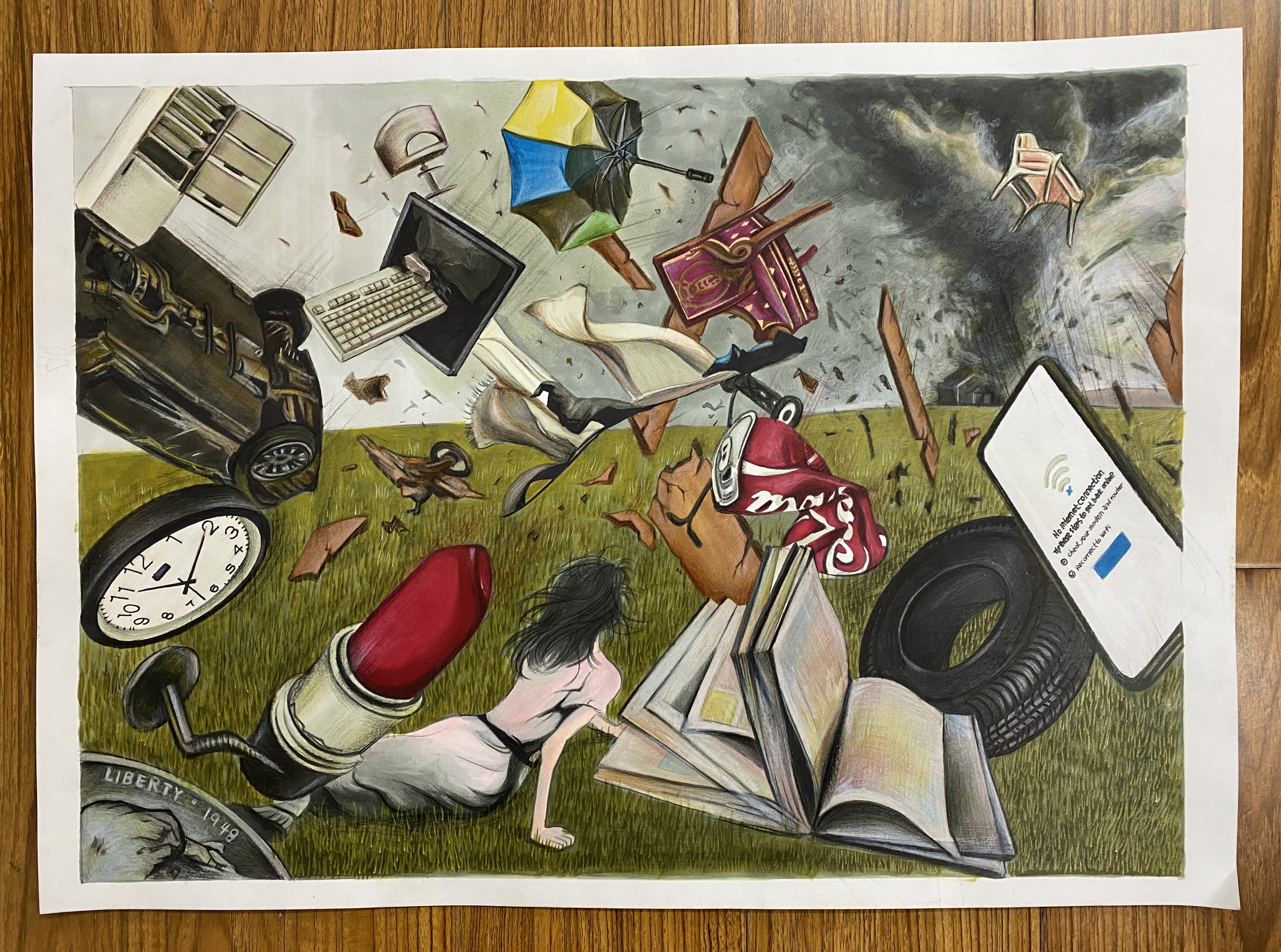
Nature's World
This work is a remake of Andrew's Wyeth's Christina's World. The horizon line of the original work is lowered in order to add emphasis to the tornado which rips through the house in the background. The objects that are strewn about as a result of the destruction are selectively chosen. Regardless of how we transport ourselves (car), what knowledge we acquire (book), the technology we develop (computer, cell phone), what we eat or drink (fridge and coke), our leisure activities (lipstick and clothes), what we build (boards and nails), or even our construct of time (the clock) and money (the coin), we are ultimately beholden to the primal forces of nature. The year on the US nickel (1948) is a nod to Wyeth's original work while the clock's hands, pointing to 9 and 11, are a foreboding reminder of humanity's choice to either live in harmony with nature or continue to exploit it. In the end, nature will have the final say.
04
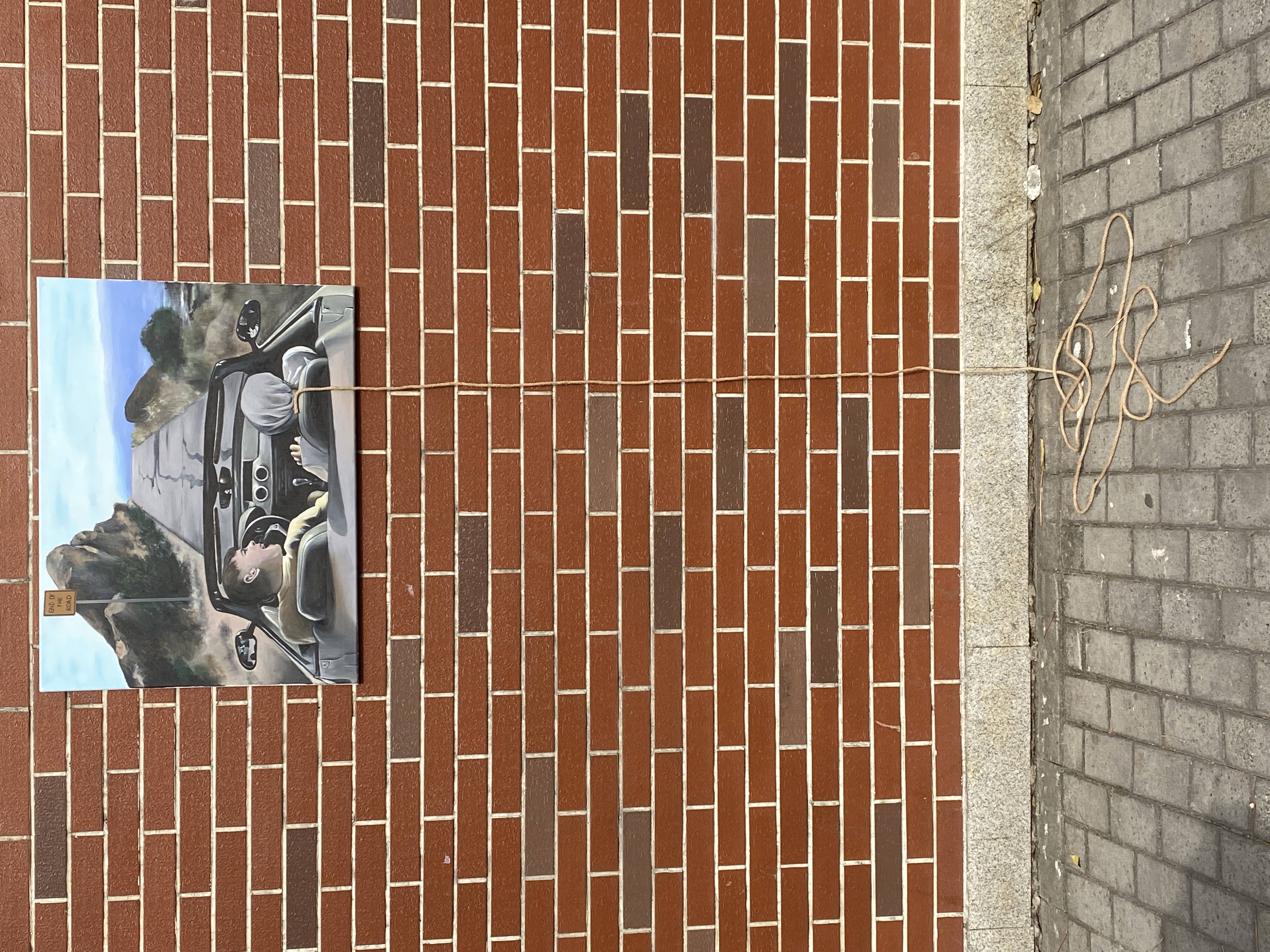
Money Game Part 3.02
Inspired by Money Game Part 3, by Ren, I chose to compose a work that surmises and reiterates what's truly worth focusing on in our lives. Ren drives his car (a metaphor for his life) but he is heading towards a cliff as he argues with his father (depicted with a bag over his head) in the passenger seat. The side mirrors on the car reference his money making past, namely his sale of software code at 17 (right) and his business shift towards dealing arms at 26 (left.) The center mirror depicts the present, the life changing phone call that comes at the age of 35, informing him of his father's death. Upon hearing the news, Ren spins out of control, becoming reckless and hungry for power. Ren (or more accurately, Jimmy, the character he portrays) ends up getting shot and finds himself unable to walk. His newfound perspective leaves him with a heavy conscience. The "End of the Road" sign forshadows Jimmy's destiny, or as Ren succinctly states, "a fortunate fool with an unfortunate fate."

05
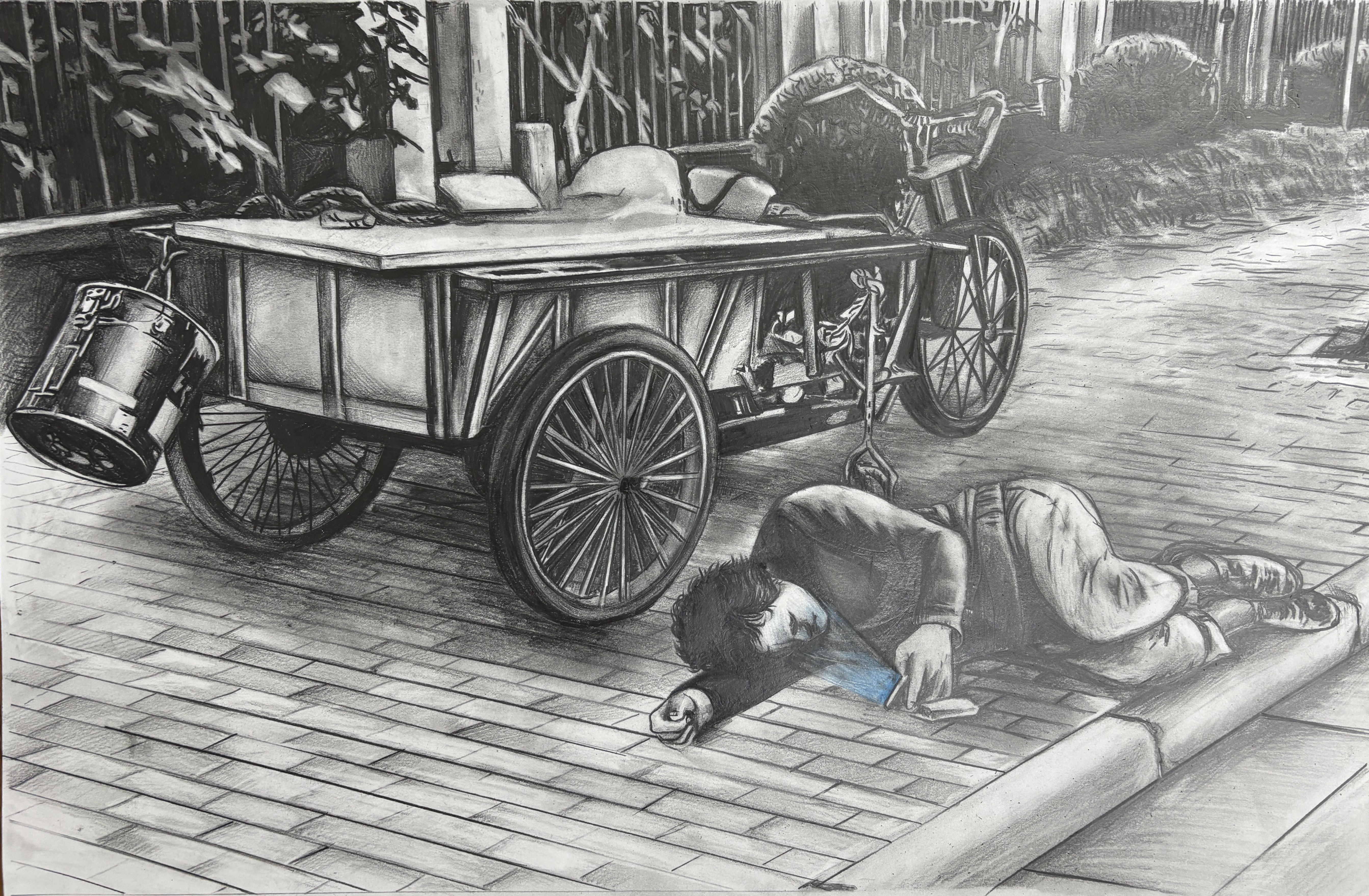
Glow
This work is based off a photograph that I took in Shanghai. The image references a random street worker who is lying down on the sidewalk near the edge of a road. As poor as the man is, he still possesses a cell phone. What he's watching is not important compared to the effect that watching the cell phone has on him. This effect it has on the man no different than it is for the rest of society. It's a moment that's indicative of the fact that no matter what class or social group we belong to, our devices have had an addictive effect on us. The image is composed in various values with the main figure placed at the bottom of the picture plane. The cell phone, which emits a blue glow, is the only thing composed in color so as to provide visual emphasis. Glow serves as a clarion call to rethink our ever-evolving relationship with technology.

06
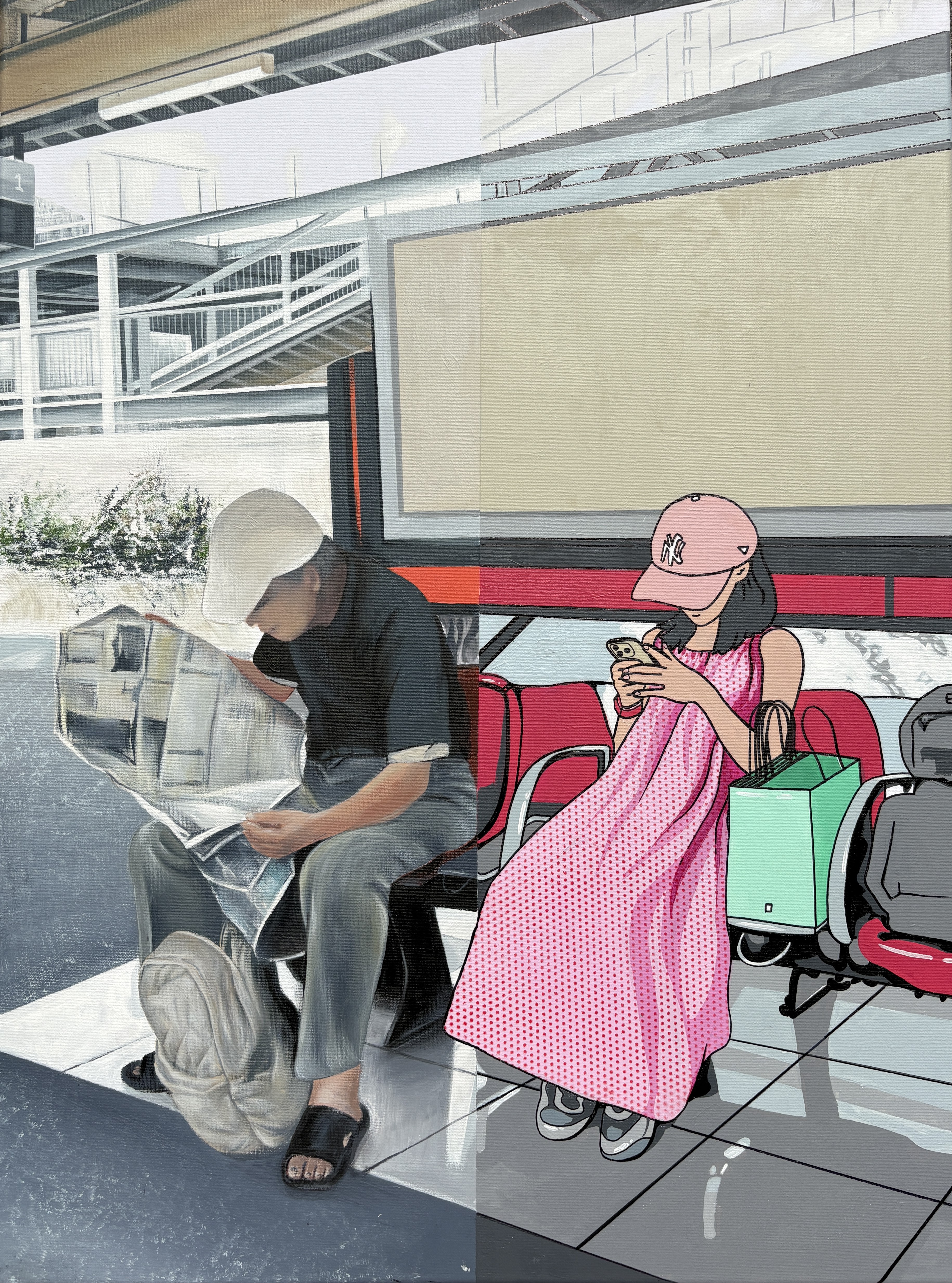
Generations
This simple scene of an old man beside a young woman at a bus stop is anything but ordinary. Upon closer examination of the painting, one will notice that the two individuals are both engaged in various forms of media and technology. For the old man, he is focused on reading a dying medium, the newspaper. For the young woman, she is using the latest technology, her cell phone. The image itself, while composed in the same medium, is rendered in different styles. On the left side of the picture plane, the old man is painted in a traditional, realistic manner. On the right, the young woman is composed in a modern, pop-art style (including Ben-Day dots.) So while the two figures occupy the same space and are essentially engaged in some form of media, they are generations apart and the style in which they're composed is indicative of that.
07
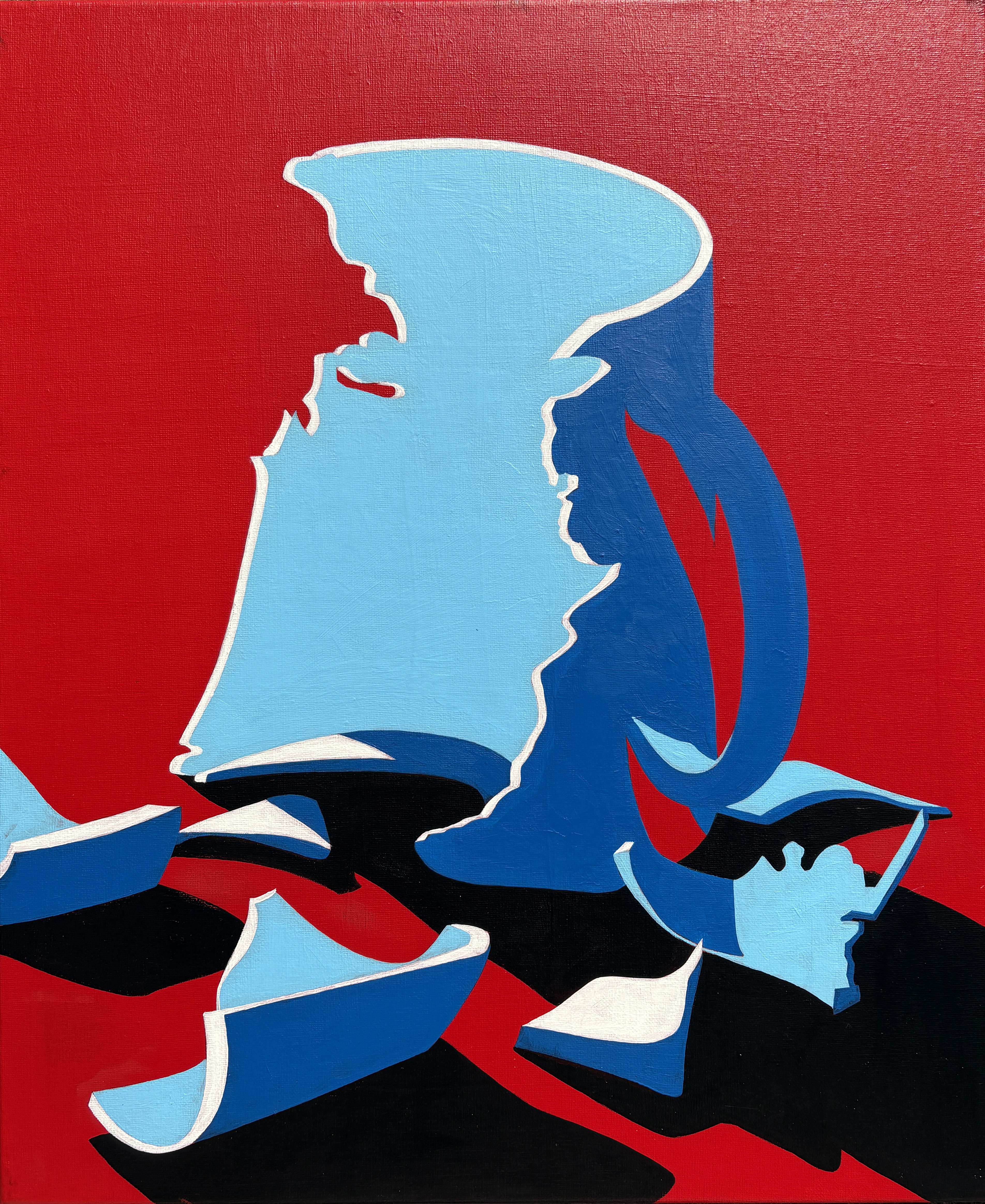
Mug Shot
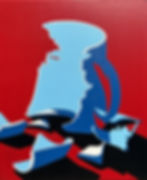
Two-thirds of American adults drink coffee each day, higher than past-day consumption of tea, juice, soda, and bottled water. It's therefore fair to say that coffee holds a unique place in Americans’ daily lives. One could easily argue that regardless of where they are on the political spectrum, coffee is one of the few things that Americans agree on. In this work, entitled Mug Shot, the image of a broken coffee mug is depicted. However, if one looks closely, they will notice that the fractured edges of the mug are telling a story beyond that of a broken cup. Using the element of line, both the northern and southern borders of the United States form the edges of the split. Alaska, manifested as the twisted piece in the bottom right corner, is also included. The work is simple by design and is painted in red, white and blue as further context. With trade wars fuelling even higher coffee prices, it can be a difficult time to embrace optimism, regardless of one's political affiliation.

08
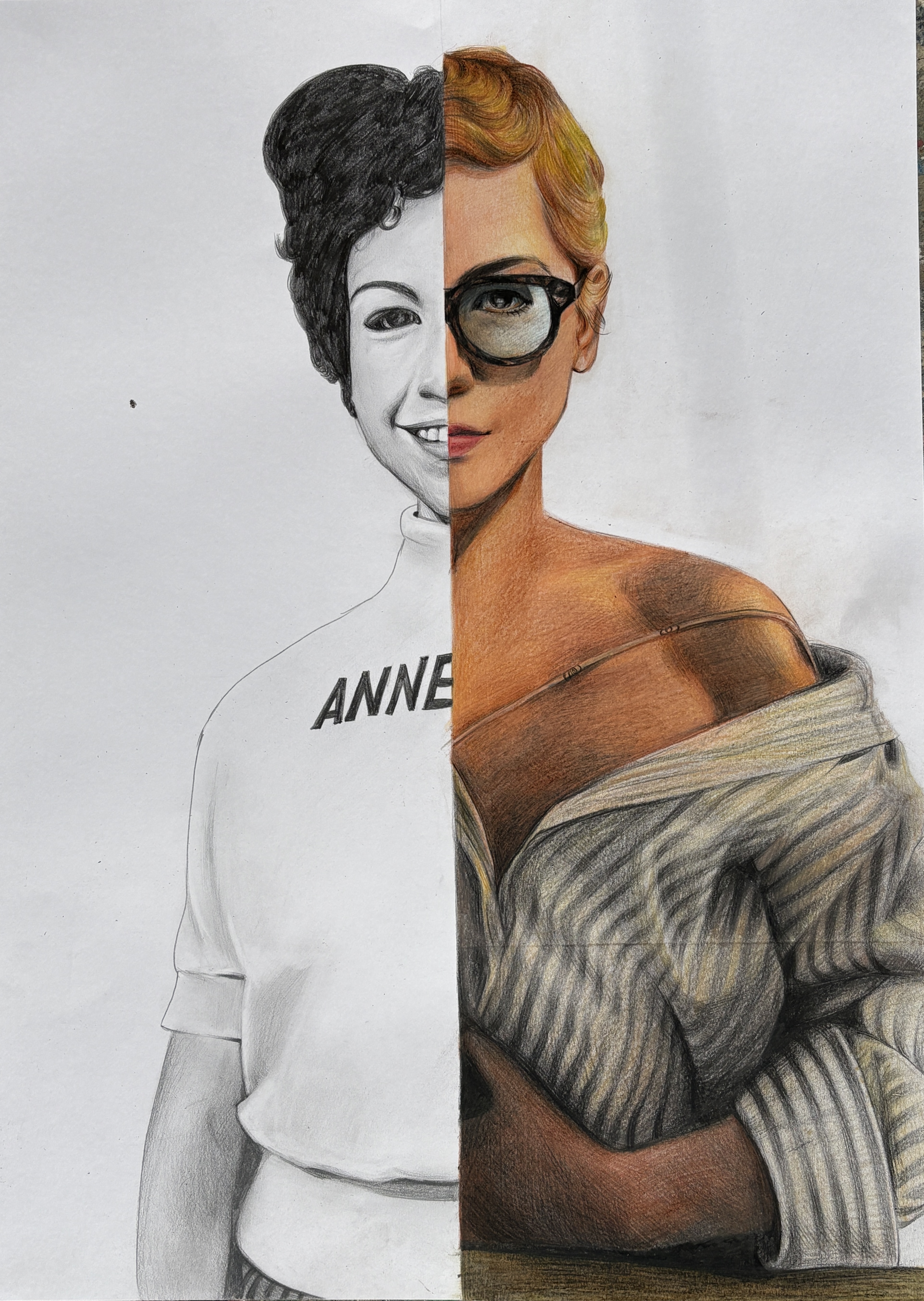
Where Dreams Come True
The image juxtaposes Annette Funicello against Michelle Williams. Both are actresses. Both worked for Disney. What's different is not so much their roles but how Disney has shifted in the ever-changing landscape of American pop culture. In this work, aptly entitled Where Dreams Come True, Annette is shown as one of the original Disney Mouseketeers from the 1950s. She had a girl-next-door lovability that was considered to be wholesome, sweet, and natural. Fast forward to 2025 where Disney's "Dying for Sex" offers its viewers content involving a variety of sexcapades including, but not limited to, masturbation, BDSM sex parties, “pup play”, and finding one's way round a cock cage. It's fair to say that Disney has definitely rebranded itself as their slogan, "The Happiest Place on Earth" has taken on a vastly different meaning.
01 / 08
Bleached
The oversized fingerprint in this work is painted on black cloth using bleach. By definition, to bleach something means to cause a material such as cloth, paper, or hair, to become white or much lighter by a chemical process or by exposure to sunlight. This idea of exposure, specifically by means of privacy, is of paramount importance in our society today. It begs us to ask the question, "Do we really live in a free society where our every move, be it digitally or physically, is tracked and monitored?" While there are those who would argue that if you haven't done anything illegal, you shouldn't have to worry. But the fact is, if history has taught us one thing, it's that you don't have to do illegal things to be suppressed, marginalized, investigated, or in extreme cases, sent to prison camps. Having painted the cloth with bleach, the individual is exposed by way of their indexical mark, and in doing so, is made available for all to see, regardless of their right to privacy.
01
Bleached
The oversized fingerprint in this work is painted on black cloth using bleach. By definition, to bleach something means to cause a material such as cloth, paper, or hair, to become white or much lighter by a chemical process or by exposure to sunlight. This idea of exposure, specifically by means of privacy, is of paramount importance in our society today. It begs us to ask the question, "Do we really live in a free society where our every move, be it digitally or physically, is tracked and monitored?" While there are those who would argue that if you haven't done anything illegal, you shouldn't have to worry. But the fact is, if history has taught us one thing, it's that you don't have to do illegal things to be suppressed, marginalized, investigated, or in extreme cases, sent to prison camps. Having painted the cloth with bleach, the individual is exposed by way of their indexical mark, and in doing so, is made available for all to see, regardless of their right to privacy.
02
Nothing to See Here
Is democracy dying? This work, entitled, Nothing to See Here, plays on the idea of perspective, specifically in regards to what the masses are focused on as opposed to what's really going on. The painting presents a panoptic structure that gazes down upon their citizens. The two way windows of the watchtower act as a facade. Authoritarian power presents a smiley face, painted in bright yellow that personifies an outward appearance of optimism or pleasure. This image is seized by an ignorant populace who dismiss the obvious in favor of embracing their own enslavement. Armed with batons and show or force, the symbols of state machinery fan out in a sunburst pattern indicative of an agitprop poster from days gone by. Painted in pink, the authoritarian regime saps the energy of the populace. The work functions as a stark reminder that if we forget the past, we are condemned to repeat it.
03
Nature's World
This work is a remake of Andrew's Wyeth's Christina's World. The horizon line of the original work is lowered in order to add emphasis to the tornado which rips through the house in the background. The objects that are strewn about as a result of the destruction are selectively chosen. Regardless of how we transport ourselves (car), what knowledge we acquire (book), the technology we develop (computer, cell phone), what we eat or drink (fridge and coke), our leisure activities (lipstick and clothes), what we build (boards and nails), or even our construct of time (the clock) and money (the coin), we are ultimately beholden to the primal forces of nature. The year on the US nickel (1948) is a nod to Wyeth's original work while the clock's hands, pointing to 9 and 11, are a foreboding reminder of humanity's choice to either live in harmony with nature or continue to exploit it. In the end, nature will have the final say.
04
Money Game Part 3.02
Inspired by Money Game Part 3, by Ren, I chose to compose a work that surmises and reiterates what's truly worth focusing on in our lives. Ren drives his car (a metaphor for his life) but he is heading towards a cliff as he argues with his father (depicted with a bag over his head) in the passenger seat. The side mirrors on the car reference his money making past, namely his sale of software code at 17 (right) and his business shift towards dealing arms at 26 (left.) The center mirror depicts the present, the life changing phone call that comes at the age of 35, informing him of his father's death. Upon hearing the news, Ren spins out of control, becoming reckless and hungry for power. Ren (or more accurately, Jimmy, the character he portrays) ends up getting shot and finds himself unable to walk. His newfound perspective leaves him with a heavy conscience. The "End of the Road" sign forshadows Jimmy's destiny, or as Ren succinctly states, "a fortunate fool with an unfortunate fate."
05
Glow
This work is based off a photograph that I took in Shanghai. The image references a random street worker who is lying down on the sidewalk near the edge of a road. As poor as the man is, he still possesses a cell phone. What he's watching is not important compared to the effect that watching the cell phone has on him. This effect it has on the man no different than it is for the rest of society. It's a moment that's indicative of the fact that no matter what class or social group we belong to, our devices have had an addictive effect on us. The image is composed in various values with the main figure placed at the bottom of the picture plane. The cell phone, which emits a blue glow, is the only thing composed in color so as to provide visual emphasis. Glow serves as a clarion call to rethink our ever-evolving relationship with technology.
06
Generations
This simple scene of an old man beside a young woman at a bus stop is anything but ordinary. Upon closer examination of the painting, one will notice that the two individuals are both engaged in various forms of media and technology. For the old man, he is focused on reading a dying medium, the newspaper. For the young woman, she is using the latest technology, her cell phone. The image itself, while composed in the same medium, is rendered in different styles. On the left side of the picture plane, the old man is painted in a traditional, realistic manner. On the right, the young woman is composed in a modern, pop-art style (including Ben-Day dots.) So while the two figures occupy the same space and are essentially engaged in some form of media, they are generations apart and the style in which they're composed is indicative of that.
07
Mug Shot
Two-thirds of American adults drink coffee each day, higher than past-day consumption of tea, juice, soda, and bottled water. It's therefore fair to say that coffee holds a unique place in Americans’ daily lives. One could easily argue that regardless of where they are on the political spectrum, coffee is one of the few things that Americans agree on. In this work, entitled Mug Shot, the image of a broken coffee mug is depicted. However, if one looks closely, they will notice that the fractured edges of the mug are telling a story beyond that of a broken cup. Using the element of line, both the northern and southern borders of the United States form the edges of the split. Alaska, manifested as the twisted piece in the bottom right corner, is also included. The work is simple by design and is painted in red, white and blue as further context. With trade wars fuelling even higher coffee prices, it can be a difficult time to embrace optimism, regardless of one's political affiliation.
08
Where Dreams Come True
The image juxtaposes Annette Funicello against Michelle Williams. Both are actresses. Both worked for Disney. What's different is not so much their roles but how Disney has shifted in the ever-changing landscape of American pop culture. In this work, aptly entitled Where Dreams Come True, Annette is shown as one of the original Disney Mouseketeers from the 1950s. She had a girl-next-door lovability that was considered to be wholesome, sweet, and natural. Fast forward to 2025 where Disney's "Dying for Sex" offers its viewers content involving a variety of sexcapades including, but not limited to, masturbation, BDSM sex parties, “pup play”, and finding one's way round a cock cage. It's fair to say that Disney has definitely rebranded itself as their slogan, "The Happiest Place on Earth" has taken on a vastly different meaning.
bottom of page